


The end of their lives
At only six weeks old or even fewer, chickens reach the size they are killed.
The chicken industry in New Zealand slaughters around 120 million chickens every year. In one slaughterhouse, as many as 50 thousand chickens could be slaughtered in one day.
New Zealand law requires chickens to be stunned unconscious before they have their throats cut. Because of the sheer number of birds and the speed at which these slaughterhouses operate, there is plenty of potential for failure, leading to injury, maiming and slaughter without effective stunning of the birds.
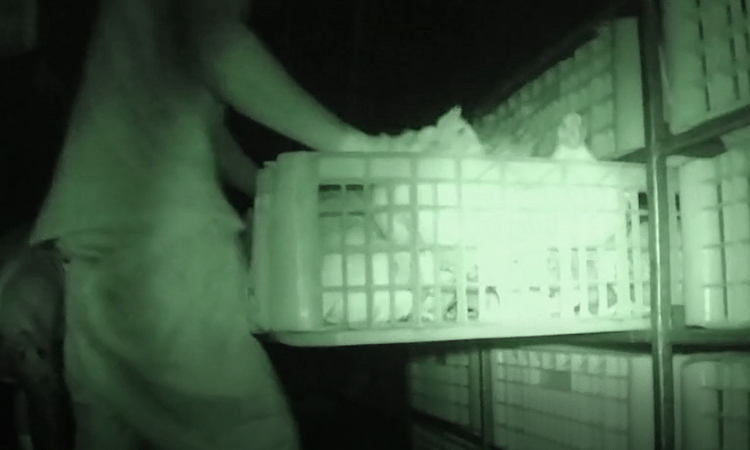
Transported with no food or water
The journey to the slaughterhouse may be the first time these chickens have been outside. They are in open-mesh plastic crates, deprived of food and water.
It is legal for food to be withheld for up to 12 hours prior to their arrival at the slaughterhouse. This is especially bad for these chickens who are bred to be constantly hungry.
As these journeys happen year-round, this can expose the birds to extremes of temperature, especially those on the outer sides of the trucks.

Risk of injuries during handling
At the slaughterhouse, chickens are hung upside down with their feet forced into metal shackles on a conveyor belt. The speed at which workers shackle the birds means the birds can get injuries, including broken legs and wings.
Even without injuries, the process is stressful and likely to be very painful, especially for the chickens who are already lame.

Risk of not being properly stunned before slaughter
With the high number of chickens passing through a slaughter line per hour, there is plenty of potential for birds to fail to be properly stunned.
According to a 2019 study carried out for the European Commission, due to a combination of high line speeds, struggling chickens, and varying current in the waterbath, there are always chickens that fail to be stunned. In one study this amounted to 60% of the chickens. This means the chickens are fully conscious when their throats are cut.
The stunning failure rates are not reported in New Zealand and therefore unknown, but there is no reason why this would be any different from overseas, where they used the same waterbath slaughter system on the same type of chickens.

Risk of being maimed
The processes used at slaughterhouses are heavily automated, yet chickens vary in size. After passing through a waterbath, the chickens are supposed to be killed with a blade across their throats. Large chickens may just be maimed by being slashed across the breast and small ones across their face. Those who receive an insufficient cut to the neck, as well as not being stunned, feel the subsequent agony of being scalded alive.